Most data center failures don't announce themselves. They show up in the data for days — or weeks — before anyone notices.
The difference between an incident and a story isn't the hardware. It's the telemetry. Without it, you don't have an infrastructure problem. You have a visibility problem.
1You find out about failures from a ticket (or a phone call)
If the first warning of an overload is "the rack went dark", you're reacting, not preventing.
A modern PDU publishes load per phase, output current and temperature every few seconds. If that data never reaches a central panel, you don't really have it — you have it "when someone calls".
What monitoring does: alerts when a phase crosses the threshold you set — not when the breaker trips.
2You don't know how much capacity you actually have left
"We have headroom" is a feeling, not a fact, until someone measures it.
Without per-phase, per-rack readings, capacity planning runs on estimates. With them, you know exactly where the next load fits — and where it doesn't.
3Your UPS batteries are a black box
Runtime remaining, capacity, last self-test result, estimated replacement date. If it's not in front of you, your backup power is a promise, not a fact.
A degraded battery doesn't fail while the grid is up. It fails exactly when you need it.
4You detect heat by smell, not by sensor
Hot spots, water leaks, open doors. All of it is measurable — temperature, humidity, leak and door sensors — and all of it warns you before it becomes an outage.
Correlating return-air temperature against rack load is what separates "it's warm in here" from "this row is about to fail".
5Nobody has a single source of truth
When facilities reads a spreadsheet, network has its own tool and management asks for a report, everyone holds a different version of the same data center.
One panel — same numbers, in real time — ends the debate and speeds up every decision.
How to fix it
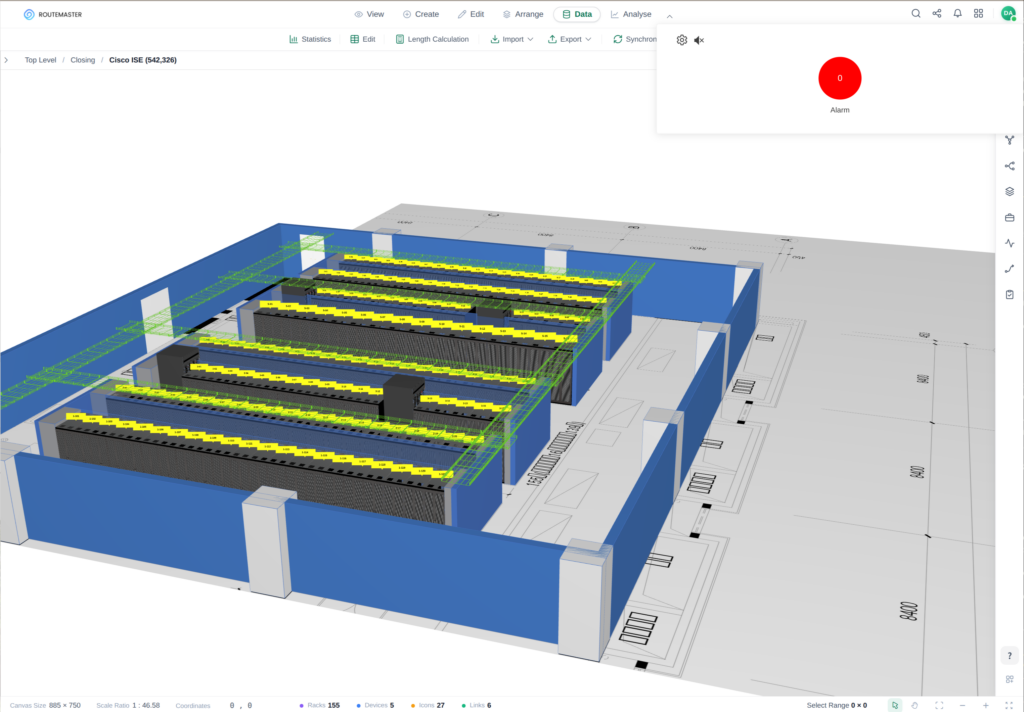
RouteMaster Monitoring polls PDUs, UPS, CRACs, batteries and switches over SNMP every 60 seconds, evaluates thresholds and trends, and alerts you where you choose — with the affected asset highlighted in place.
No agents to install on your equipment. No rip-and-replace. Open standards, running on your network.
Which of these 5 signs do you recognise in your setup? Tell me in the comments.