
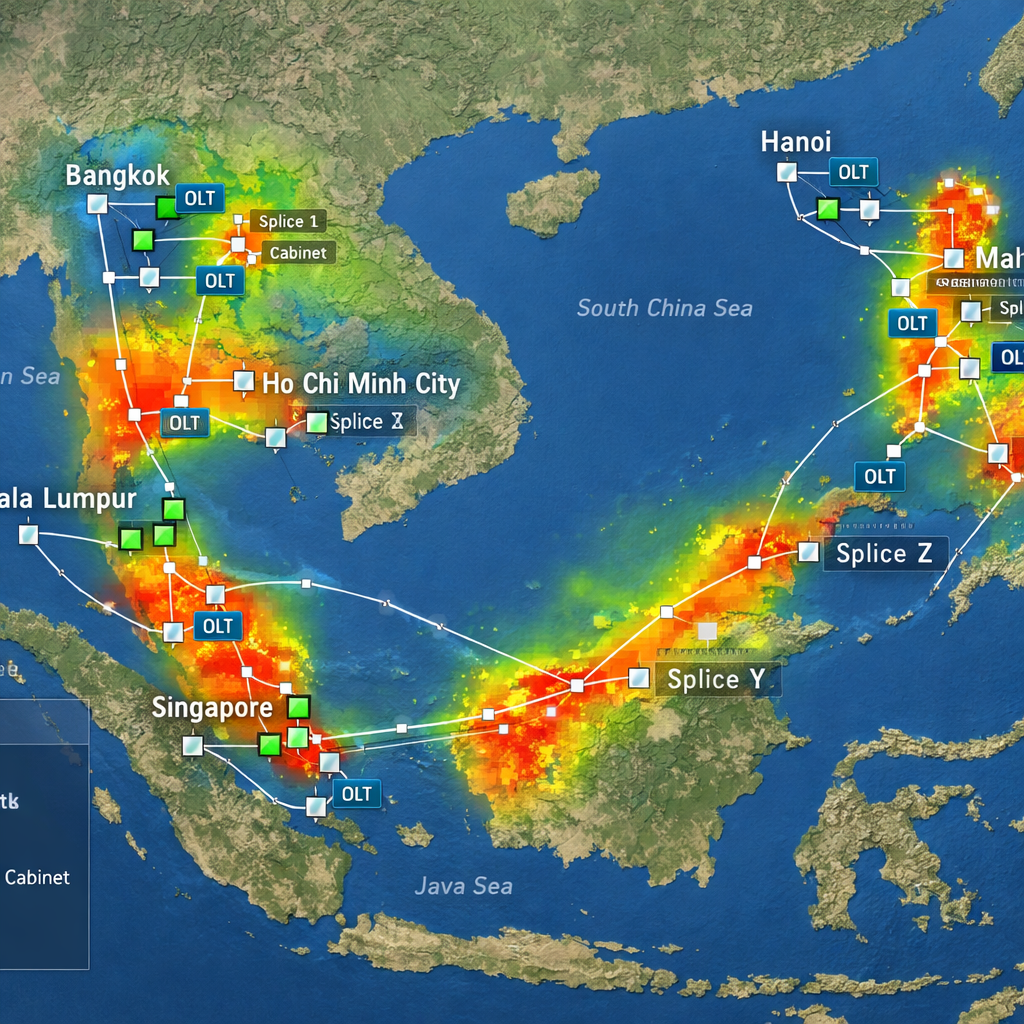
One of the Fastest Fiber Expansions in History
Southeast Asia is deploying fiber at a pace and scale that's genuinely unprecedented. Indonesia, Philippines, Vietnam, and Thailand have collectively committed to over $15 billion in FTTH infrastructure between 2025 and 2028. Governments are mandating universal broadband. ISPs are racing to deploy. The pressure is on—and it's not letting up.
The Problem No One's Talking AboutDeploying at Scale Breaks Traditional Planning Tools
Spreadsheets can't handle dynamic splice management. Legacy GIS shows you where cables go, but not how they'll perform under load. And most critically: field teams are building networks that planning teams can't fully visualize—creating a knowledge gap that causes expensive mistakes when it's time to expand or repair.
Field teams are building networks that planning teams can't fully visualize. Every undocumented splice is a future truck roll. Every unmapped fiber is a future outage.
A Real Example From the Field
A major ISP recently showed us their challenge: 50,000+ new fiber drops planned for Q1, but their design team was working in AutoCAD and Excel. Splice points weren't traceable. Capacity planning was guesswork. Field crews were improvising routes that didn't match plans—creating a fragile, undocumented network that grows more expensive to manage every day.
FTTH Networks Are Living Systems
They evolve constantly—new drops, repairs, capacity upgrades. If your design tool doesn't create a digital twin that stays current with the physical network, you're building technical debt at scale. The real cost isn't in the initial deployment. It's in every improvised repair, every undocumented splice, every outage traced back to a fiber that wasn't in the plan.
- Every undocumented splice is a future truck roll
- Every unmapped fiber is a future outage
- Every planning-to-field gap is compounding technical debt
- Expansion becomes a nightmare instead of a competitive advantage
Built for This Reality
Our FTTH/OSP platform was designed from the ground up for networks that live and breathe. GIS-powered planning meets splice management meets field documentation—in a single, integrated environment. When the digital twin matches the physical network, everything changes. Expansion becomes predictable. Repairs become faster. And the compounding cost of technical debt stops at the door.
Is Your Design Platform Ready for What's Coming?
See how Routemaster helps network planners stay ahead of rapid FTTH expansion across Asia-Pacific.
Request a Demo